

For many students, the biggest obstacle to learning advanced subjects isn’t motivation. It’s access.
A teenager with an interest in electronics might have plenty of questions but no laboratory. Someone fascinated by physics may have the curiosity to learn but not the money to enroll in advanced courses. And an aspiring engineer may understand the basics while struggling to find reliable material that explains what comes next.
That is where open education can make a major difference.
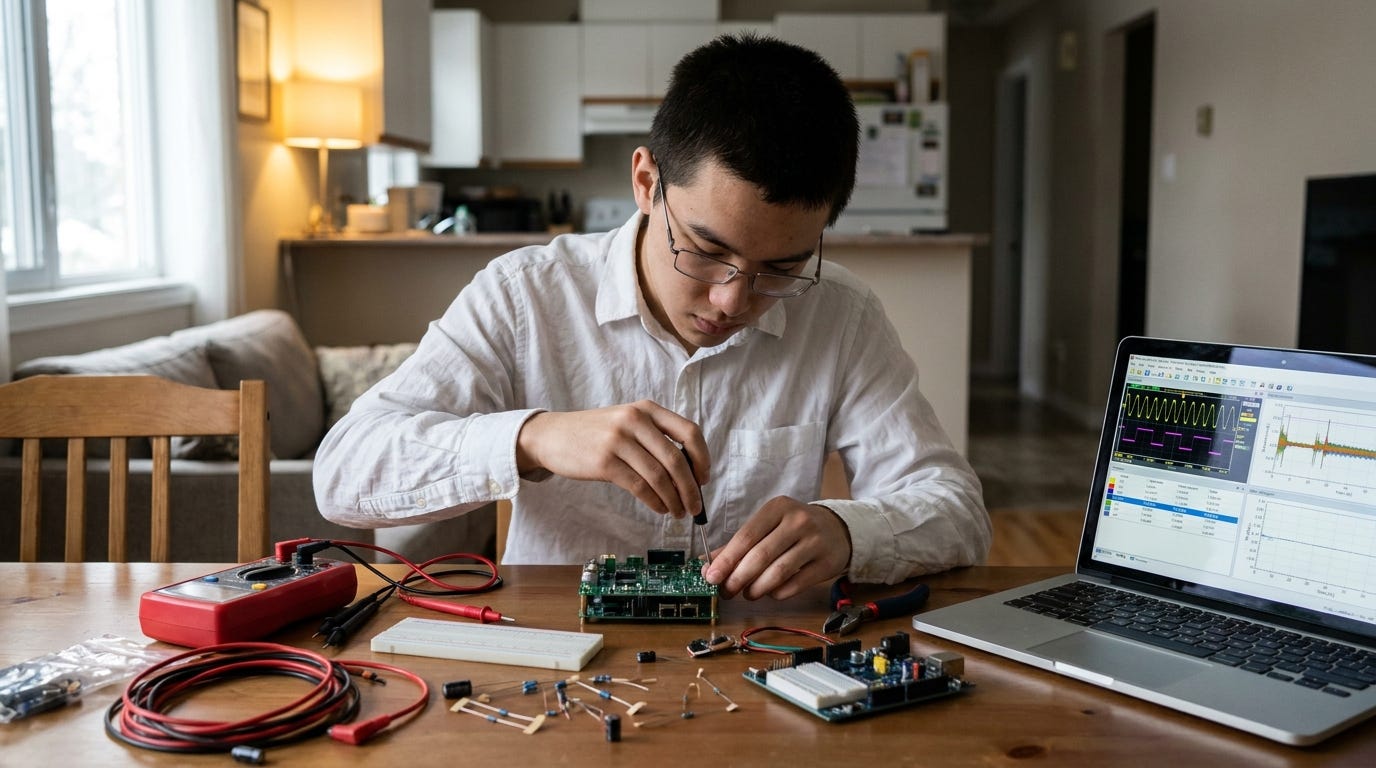
Imagine a student named Daniel, living in a small town in southern Chile. While working on a school project involving sensors and human movement, he quickly discovered that building a prototype was much easier than understanding why the measurements were unreliable.
His device produced inconsistent readings. Sometimes the signal looked correct; other times it was overwhelmed by noise.
Instead of abandoning the project, Daniel began searching for university-level material covering electronics, signal processing and biomedical engineering.
What changed his approach was discovering that many of these subjects could be studied online through freely available university course materials.
Rather than relying on short tutorials or fragmented explanations, he began working through complete lectures, assignments and technical notes. Slowly, concepts that had previously seemed abstract started becoming practical tools.
Noise was no longer simply something that “went wrong.” He could understand where it came from. Circuit design became easier to reason about. Signal processing stopped looking like a collection of complicated formulas and started becoming a method for extracting useful information from messy data.
The important part wasn’t simply learning more theory.
It was learning how to solve problems.
That distinction matters.
Traditional education often measures whether a student can remember information or pass an examination. Independent learning can be different. When someone is trying to repair a prototype or understand why an experiment failed, there is an immediate reason to find the answer.
The knowledge has somewhere to go.
This is one of the most interesting possibilities created by open educational resources. A student doesn’t necessarily have to wait until university to encounter university-level ideas.
Someone interested in electronics can explore circuits. A future computer scientist can study algorithms. An aspiring physicist can work through advanced mathematics. A student interested in medicine or biomechanics can begin understanding how sensors, signals and human movement are connected.
And the effect can go beyond academics.
For an independent learner, completing a difficult course can create something that is harder to measure on a transcript: confidence.
The first time a complicated technical problem becomes understandable, the student begins approaching future problems differently.
Instead of asking, “Can I do this?”
The question becomes:
“What do I need to learn to solve it?”
That mindset can be just as valuable as the technical knowledge itself.
Open education also changes the geography of learning. A student doesn’t necessarily need to live near a major university to access high-quality educational material. With an internet connection and enough determination, someone studying in a small town can explore subjects taught at institutions thousands of kilometres away.
Of course, free online courses are not a replacement for everything universities provide. Laboratories, professors, classmates, mentorship and formal qualifications still matter enormously.
But open educational platforms can remove one important barrier: the assumption that advanced knowledge has to remain behind a classroom door .
The bigger lesson is perhaps not about any particular university or platform.
It is about what happens when curiosity meets access.
Give a motivated learner the right resources, enough time, and a real problem to solve, and the internet can become much more than a place to consume information.
It can become a laboratory.
And sometimes, the first step toward becoming an engineer isn’t getting accepted into an engineering program.
It’s simply deciding to start learning.