


For a long time, I thought good lecture notes meant writing as much as possible.
The professor would start explaining something, and I would try to copy every definition, example, and sentence before moving on to the next point. By the end of the lecture, I had several pages of notes—but when I looked at them later, I often couldn’t remember what any of it meant.
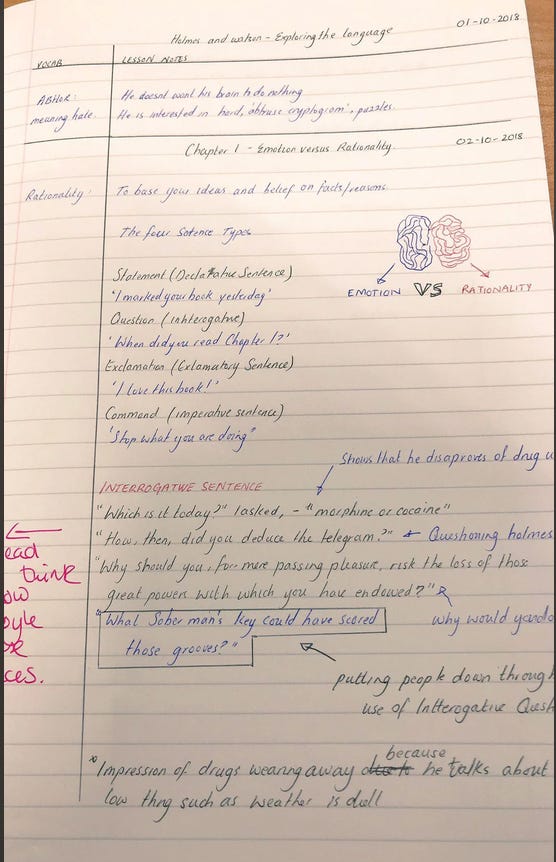
Eventually, I changed the way I take notes.
Now, when I’m sitting in a lecture, I focus less on transcribing and more on understanding and organizing information.
Here is what my notes usually look like.
1. I start with the big idea
At the top of the page, I write the subject of the lecture and the date.
Then I try to identify the main idea.
For example, in one of my lectures, the topic was “Emotion versus Rationality.”
Instead of immediately writing everything the professor said, I wrote the central concept first:
Rationality: To base your ideas and beliefs on facts/reasons.
This gives me something to build around.
When I review my notes later, I don’t have to search through an entire page to figure out what the lecture was about.
2. I write concepts in my own words
One of the biggest changes I made was stopping myself from copying definitions word-for-word.
If the professor gives a complicated definition, I try to rewrite it in a simpler way.
For example, instead of filling my page with a long explanation, I might write:
Rationality → making decisions based on facts and reasons.
The goal isn’t to create a perfect transcript.
The goal is to create notes that I can understand when I read them a week later.
3. I use examples
Whenever the professor gives an example that makes a concept easier to understand, I write it down.
In the lecture shown in my notes, we were discussing different types of sentences:
Statement
Question
Exclamation
Command
Rather than writing only the definitions, I added examples such as:
“I marked your book yesterday.”
“When did you read Chapter 1?”
“I love this book!”
“Stop what you are doing.”
Examples are extremely useful when studying later because they turn an abstract definition into something concrete.
4. I connect ideas with arrows
I don’t try to make every part of my notes look perfectly organized.
Sometimes I draw arrows everywhere.
An arrow might mean:
This idea explains that idea.
Or:
This example supports this concept.
Or even:
The professor just made an important connection.
For example, I connected the ideas of emotion and rationality visually instead of explaining the relationship with a huge paragraph.
This makes the page feel more like a map of the lecture rather than a collection of sentences.
5. I mark things that the professor emphasizes
One of the most valuable things you can capture during a lecture isn’t necessarily what is written on the board.
It’s what the professor emphasizes.
If they repeat something, spend a long time explaining it, give several examples, or say something like “This is important,” I make a note of it.
Sometimes I’ll write a short comment in the margin:
Important
Why?
Example
Possible exam question
These small annotations help me remember what deserves more attention when I study.
6. I write questions—not just answers
This is probably one of my favorite parts of my note-taking system.
If something makes me curious or confused, I don’t try to hide it.
I write the question down.
For example, in my notes, I wrote questions around the professor’s examples and explanations.
A question can become a study prompt later.
Instead of looking at my notes and thinking:
“I need to study this.”
I can look at the page and ask myself:
“Can I explain why this example proves the point?”
That’s a much more active way of studying.
7. I use the margins
The margins aren’t wasted space.
I use them for quick thoughts, questions, connections, and reminders.
Sometimes I’ll write something like:
Read this twice.
Look up this word.
Ask about this.
Important example.
These notes don’t need to be beautiful. They just need to be useful.
8. I don’t worry about making my notes perfect
This took me a while to learn.
Lecture notes are not supposed to be a finished textbook.
They’re a record of your thinking while you’re learning.
There might be arrows, crossed-out words, random questions, boxes, underlined sentences, and notes written at different angles.
That’s okay.
I’d rather have messy notes that help me understand the lecture than beautiful notes that contain nothing except copied information.
My simple rule
When I’m taking notes now, I keep one question in mind:
“If I came back to this page next month, would it help me understand the lecture?”
If the answer is yes, the notes are doing their job.
I don’t need to write everything.
I need to capture the main ideas, useful examples, important connections, questions, and anything the professor emphasizes.
The purpose of taking notes isn’t to create a perfect copy of the lecture.
It’s to create a version of the lecture that your future self can actually understand.
remembered me my doing somehow these during reading school books 👍❤️😍❤️👍
I will make notes next time cuz I don't now 😭
But yes probably not knowing how to make notes effectively is the reason Iose motivation to make notes. I don't think I'll benefit from them.