


“Will AI take the job I’m studying for?”
It’s a legitimate question. Recent surveys show that students are increasingly worried about AI hurting their future job prospects, while universities are rapidly adding AI courses and minors across subjects such as psychology, biology, business and even music.
But the answer isn’t to avoid technology.
In fact, the data suggests almost the opposite.
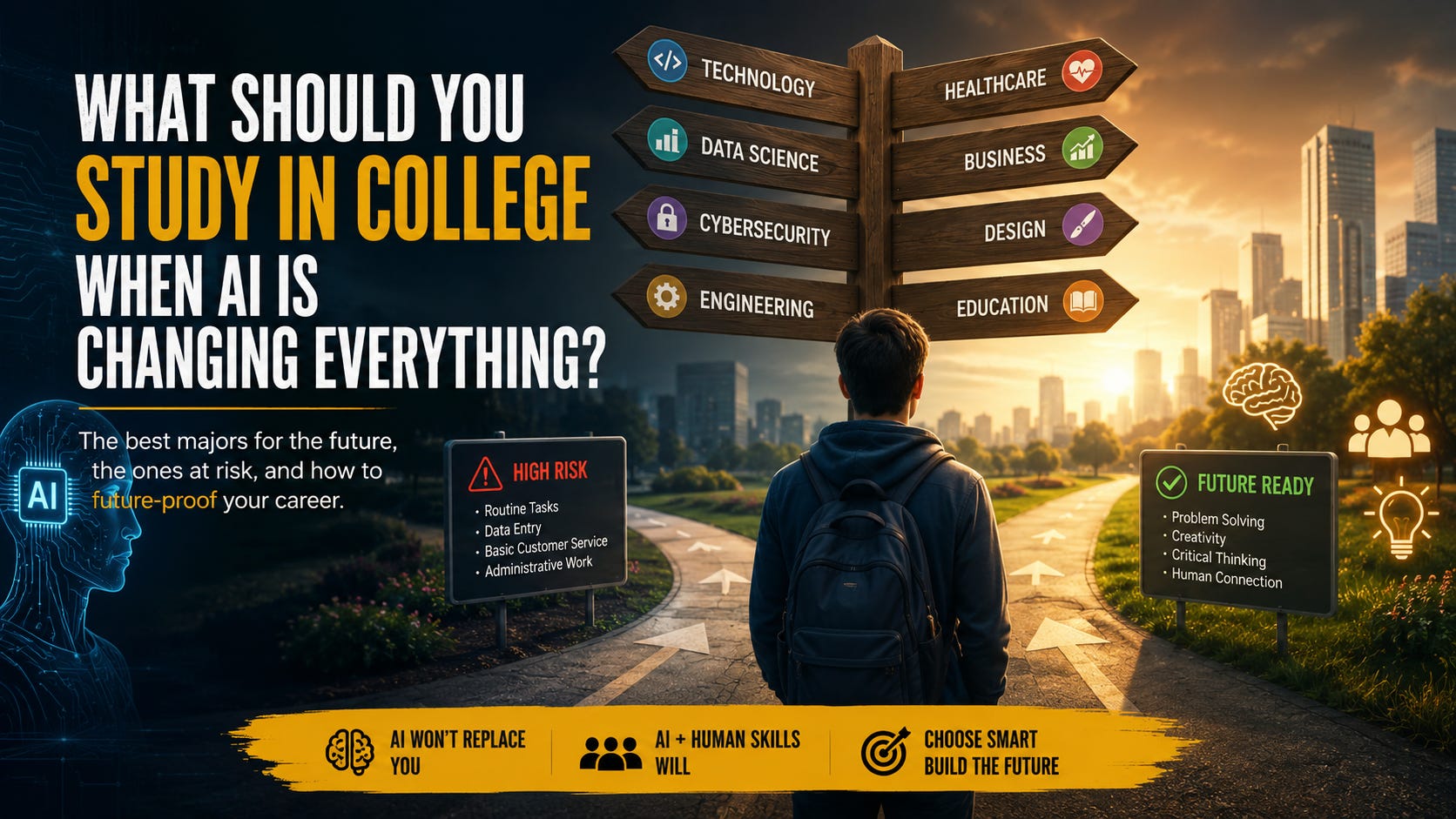
The majors that look strongest
According to the U.S. Bureau of Labor Statistics, some of the fastest-growing occupations between 2024 and 2034 include data scientists, information security analysts, nurse practitioners and software developers.
Data scientists are projected to grow 33.5%, information security analysts 28.5%, nurse practitioners 40.1%, and software developers 15.8%.
That tells us something important:
AI isn’t simply destroying technology jobs. It’s also creating demand for people who can build, manage, secure and apply AI-powered systems.
Cybersecurity is particularly interesting. As companies become more dependent on digital systems and AI, protecting those systems becomes more important, not less.
Healthcare is another strong area because it combines technology with something AI still struggles to completely replace: human interaction, physical care, responsibility and judgment.
Engineering, mathematics, statistics, computer science, healthcare and energy-related fields therefore deserve serious consideration.
But some jobs are becoming more vulnerable
The biggest risk isn’t necessarily a particular college major.
It’s choosing a career where the majority of your future work consists of routine, predictable, digital tasks.
The latest BLS projections show declines in several occupations that involve repetitive administrative or information-processing work. Customer service representatives, for example, are projected to decline 5.5% between 2024 and 2034, while legal secretaries and some other clerical occupations are also expected to shrink.
This doesn’t mean these people will suddenly become unemployed because of ChatGPT.
It means the number of people companies need to perform certain tasks may decrease.
That’s a very different — and more realistic — way to think about AI.
The real advantage may be combining skills
The World Economic Forum’s Future of Jobs Report 2025 identifies AI and big data as the fastest-growing skills, followed by networks and cybersecurity and technological literacy. But it also highlights creative thinking, analytical thinking, resilience, flexibility and leadership.
That combination is the real opportunity.
Don’t just study marketing.
Study marketing + analytics + AI.
Don’t just study computer science.
Study computer science + AI + cybersecurity + communication.
Don’t just study business.
Understand technology, data and automation.
Don’t just study healthcare.
Learn how AI and digital tools are transforming healthcare.
The future belongs less to people who know one isolated skill and more to people who can combine technical knowledge with human judgment.
So, what should a student do?
My advice is simple:
Don’t try to find a major that AI can never touch.
That major probably doesn’t exist.
Instead, choose a field where AI can make you more powerful, rather than a field where AI can easily perform most of what you do.
Learn how to use AI.
But also learn the fundamentals without it.
Build communication skills.
Learn how to solve unfamiliar problems.
Get real-world experience before graduation.
And most importantly, don’t choose a major simply because it’s popular today.
The question isn’t:
“What job is safe from AI?”
The better question is:
“What kind of person will be extremely valuable in a world where everyone has access to AI?”
That’s the question students should be asking before they choose their major.