


Most of us were taught what to study.
Very few of us were taught how to study.
From an early age, we’re told to read the chapter, take notes, highlight important sentences, memorize the material, and prepare for the exam.
Then, when we struggle, we’re usually told to simply study harder.
But what if the problem isn’t a lack of effort?
What if we’ve simply been using the wrong method?
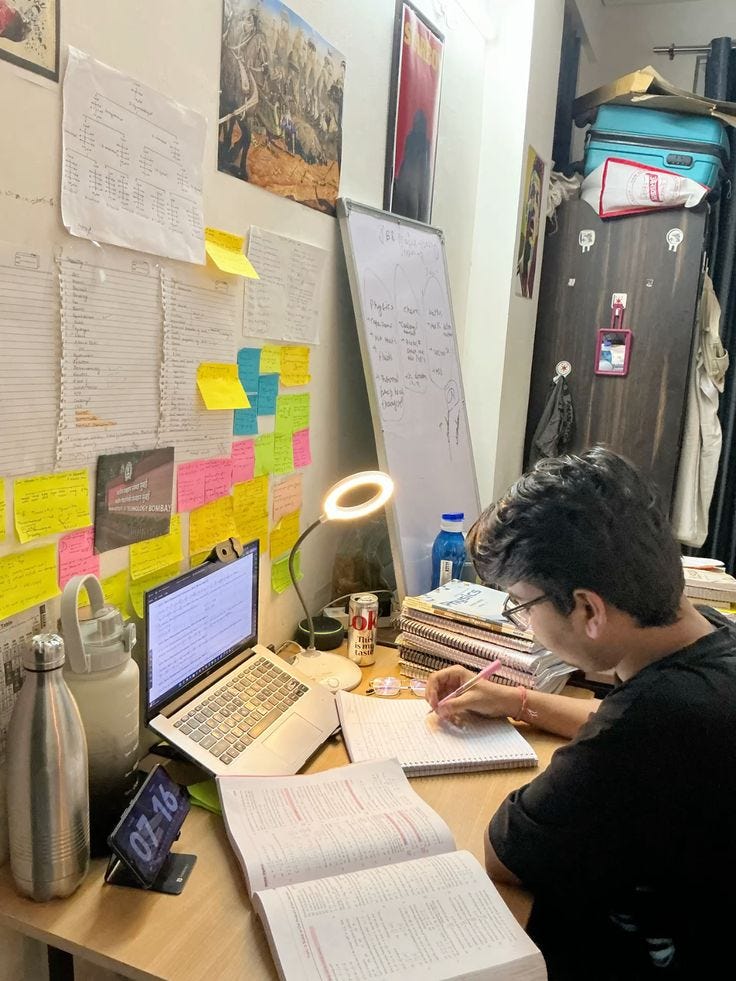
Studying isn’t the same as reading
One of the biggest mistakes students make is confusing reading with learning.
You can read an entire chapter and remember almost nothing the next day.
You can highlight dozens of pages and still struggle to explain the main concept.
You can spend five hours at your desk and make very little progress.
Why?
Because simply exposing yourself to information doesn’t guarantee that your brain has actually learned it.
Real learning requires you to think about, retrieve, explain, and use the information.
Stop measuring studying by hours
“I studied for six hours today.”
It sounds productive.
But hours aren’t the best measurement of learning.
A better question is:
What can I do now that I couldn’t do before?
If you studied a chapter for two hours but can’t explain its main ideas without looking at your notes, you probably need a different approach.
On the other hand, if you can close the textbook and explain the concepts in your own words, you’ve actually made progress.
The goal isn’t to sit at your desk longer.
The goal is to learn more effectively.
Close the textbook
One of the simplest things you can do is also one of the most powerful.
After reading a section, close the book.
Now ask yourself:
What did I just learn?
Can I explain it?
What are the main ideas?
Why does this concept matter?
Can I give an example?
If you can’t answer, that’s okay.
You’ve just discovered exactly what you need to work on.
This is much more valuable than simply rereading the same paragraph five times.
Don’t highlight everything
Highlighting can be useful, but it can also become an illusion of productivity.
If half the page is highlighted, what exactly is important?
Instead of marking everything, focus on understanding the material.
After reading, try to recreate the important information from memory.
Write down the key concepts without looking.
Then check your answers.
The things you forgot are the things you should review.
Teach yourself by teaching someone else
Here’s another powerful technique:
Explain the topic as if you’re teaching it to someone who knows nothing about it.
Use simple language.
Avoid reading directly from the textbook.
Don’t hide behind complicated terminology.
If you understand something, you should be able to explain the basic idea clearly.
And if you can’t explain it?
That’s useful.
It shows you where your understanding is weak.
Go back, study that part, and try again.
Review instead of cramming
Another common mistake is waiting until the night before an exam.
You study for hours, memorize as much as possible, take the exam, and then forget most of it afterward.
A better approach is to return to the material repeatedly.
Study it today.
Test yourself tomorrow.
Review it again a few days later.
Then come back to it again.
The spacing between sessions gives your brain more opportunities to retrieve the information.
And retrieval is exactly what you want to practice.
Your study session should feel difficult
This might sound strange, but good studying isn’t always comfortable.
If you’re constantly rereading information you already know, everything feels easy.
But easy doesn’t necessarily mean effective.
When you try to recall something without looking at the answer, you may struggle.
That struggle is useful.
When you attempt a practice problem and get it wrong, that’s useful too.
When you try to explain something and realize you don’t fully understand it, that’s useful.
Mistakes reveal what you need to learn.
A simple study system
Next time you sit down with a textbook, try this:
1. Preview the chapter.
Look at the headings, diagrams and key sections.
2. Set a goal.
Know what you want to understand before you start.
3. Read actively.
Don’t just move your eyes across the page. Ask questions.
4. Close the book.
Try to recall what you just learned.
5. Explain it.
Put the concept into your own words.
6. Find your weaknesses.
Focus your next study session on what you couldn’t remember.
7. Review later.
Don’t rely entirely on one massive study session.
It’s not complicated.
But it requires you to stop thinking about studying as time spent with a textbook.
Instead, think about studying as training your ability to understand and retrieve information.
Learn how to learn
The world has never had more information available to us.
Books, courses, lectures, tutorials, articles and educational resources are everywhere.
But having access to information isn’t the same as knowing what to do with it.
One of the most valuable skills you can develop is the ability to learn efficiently.
You don’t necessarily need to study harder.
You don’t necessarily need to study longer.
You need to understand how your brain learns best and build a system around it.
Because once you learn how to learn, every textbook becomes more valuable.
Don’t just study more. Learn how to study.
Thank you, I needed these tips✨️
It was very useful for me. Thank you👍👍